Showing posts with label tango. Show all posts

Saturday, April 4, 2015

Gustavo y Giselle Anne


Yep. There are dancers and teachers and then there are Gustavo Naveira and Giselle Anne. I can not find words to describe the feeling I get when I see them dance. I sense in their dance a mix of love, fun, beauty, respect, honor and all that added to an incredible technique and innovation they both bring to it. Tango world is better with them in it.


Watch them dance Donato: El Adiós.
  

Thursday, April 2, 2009

Atlantis

Last night I went to Atlantis, a Tallahassee bar and grill sort of restaurant with fine food and atmosphere. One half of the dig is the restaurant, the other a dance lounge sort of place with nice cabaret-style booths along one side, a raised DJ stand on the other with a large mirror in front of it, and a fairly good floor. There is dancing on most evenings.

Wednesday is advertised as the "Argentine Tango" night. I do remember several years ago coming to Atlantis on Tuesdays to dance (they switched to Wednesdays some time ago)-- I DJ-ed some of those events. Those were the days when we actually danced tandas of argentine tangos, milongas, and valses. The floor was crowded most of the time. Then things changed.

The music was really nice last night, but it was not tango at all, most of the pieces did not even resemble tango. Again, very nice, but not tango. I watched as one or two couple danced and was amused. While at least one couple danced very creatively, they did not seem to need the music to dance at all. So, clearly the fact that they moved about with some form of tango-like steps and figures to non-tango music did not matter to them.

I enjoyed the music and left after about an hour with no dancing to speak of. I miss Buenos Aires.

Clearly, for the people in Rio de la Plata region, tango is part of the culture, for the rest of the world it is only a dance.

Friday, March 20, 2009

After Milongueando 2009

It's been a month since Milongueando 2009 ended. It was a great gathering of tango lovers from around the world with those who personally witnessed its progress in the last .. oh, 40, 50, or 60 years. And it took me a year (since Milongueando 2008) to finally figure out the essential value of the gathering. I speculated about it, given the schedule of events, but only after having spoken with the two convenors, Maria Plazaola and Susana Miller, it became clear and confirmed. (My friend Shoko and I conducted video interviews with the two and will soon publish ot for all to see.)

This year, among other maestros we had Tete (and Silvia), Abel Peralta, Juan Manuel Suarez, Roberto Segarra, and Pedro Sanchez - all long time tango dancers and milongueros. Most of them with their own specific "style." And, while they were not necessarily teachers, they danced, their style evolved by dancing for decades and were in classes accompanied with teachers who could and did decompose some important aspect of the milonguero dancing in order to share it, make it accessible to us.

This was a genius concept. I hope Susana and Maria continue with it.

Sunday, February 22, 2009

Practilonga (or not)

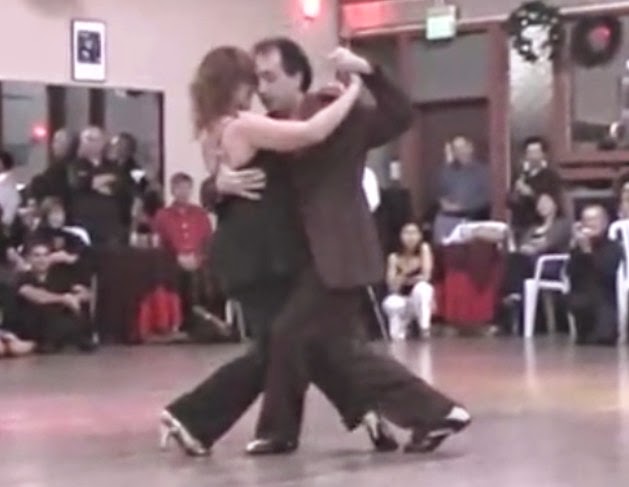
Word "practilonga" (some spell it "practi-longa") is widely accepted term (at least in the USA) used to describe a social event where a group of people dance and practice dancing tango (and milonga and tango vals). It is a word resulting from melting two words together -- "milonga" and "practica" -- both commonly used in the tango world coming from Spanish.

The "rules" of behavior at a practilonga are not as strict as at a "milonga" (strictly dancing) where one of the most important no-nos is to do any sort of coaching on the floor, where music is usually played in "tandas" (sets of 3-4 like songs with a short 30-40 second interlude), the flow of dancing is observed closely, and there is generally much lesser level of extraneous noise (chat and such).

But, unlike in a "practica" where the atmosphere is sometimes quite chaotic and almost anything goes as long as it has something to do with tango, of course, in a practilonga, those who practice are expected to be a bit more cognizant of those who want to just dance and to respect their choice to do so by limiting their experimentation and noise levels. In turn, those who just dance are expected to be tolerant of those who practice.

So, practilonga works for both worlds - dance and practice - although with somewhat lessened impact. However, a practilonga is particularly useful for the beginners. So far so good.

Recently, a distinguished member of the Argentine ex patriot community in North Florida objected to the use of the term itself, calling it atrocious, and wished it had not been used. A whole slew of responses was generated, some seriously in support of the objection, some humorously offering alternatives. Here's a sampling of alternative terms: fauxlonga, quasilonga, milotango ....
Friday, February 20, 2009

After the festival

I intended (as I did the last year) to write every day of the festival about the festival experiences, but (just like it happened the last year - I will never learn) the time was preciously divvied up on doing things rather than writing about doing things. Soooo...

In summary, the festival was great. Lots of good workshops and great socializing with dancers. I plan on returning the next year.

One thing stood out though. It took me a year to figure out at least one of the major goals of the festival. We had a score of mostly old-by-age milongueros, who are not necessarily teachers, accompanied by the teachers teach workshops. And what would usually happen was that a milonguero would show a particular sequence and the teacher would teach the technique involved in achieving whatever the milonguero was showing.

At first, I though that was sort of weird, since tango is not about sequences, as we know. But, then it dawned on me that each one of those old-timers developed something very special in their dance in an organic way - by and large they were not taught dancers, but rather they learned via a long process of dancing. And they mostly really could not teach what they were doing systematically since their dance was not in their brain but in their heart and in their body memory.

Then the expert teachers like Susana, Maria and others, would "deconstruct" what milongueros were doing, they would distill the essential elements of it and teach methodically.

So, as a result, we got the benefit of both the practitioners and the teachers. To me that is the genius of the idea behind the Encquentro Milonguero. I hope they continue the same way into the future.

Friday, February 6, 2009

On my way


In about 30 minutes, my friend, Gordon, will (likely) pick me up, drive me to the Tallahassee Regional Airport to board the plane for Miami, followed by an overnight flight to Buenos Aires!

I am staying in a friend's apartment on Ayacucho y Lavalle, close to tango things happening. This is my fifth visit and it is almost like going home, at least to my tango home.

Another friend has already left Tallahassee a few hours ago and is traveling to Buenos Aires via New York. She arrives a few hours after I do. We share the apartment.

Will attend Milongueando 2009 followed by almost two weeks of "free lancing." Can't wait.